

Super Questions About Superposition
Why somethings can be at two places at once. Yes, really!

This week I went to a Mariners baseball game and had your usual thoughts going through my head. You know, hot dogs, home runs, pitching, and quantum superposition. Your first thought must be, why were you thinking about hot dogs at a baseball game? Well, they’re delicious. That’s why! Now on to your second less obvious question, superposition…
Ari and I stayed up the night before reading one of his books on physics and the topic of quantum physics came up. His first thought, much like the majority of people that first hear about it, was how it’s even possible. Quantum is stranger than fiction and I tried to explain it all the ways I’ve heard before. A coin flipping in the air existing as both heads and tails until it lands. The double slit experiment. Yadda yadda. Pretty sure I confused myself more while I gracefully failed trying to explain how it’s logically possible to him. My wife wasn't much more impressed when I tried again later that night. Though I’d argue she understood it better than she realized when she said “kind of like I both don’t understand and don’t care anymore at this very second.” In the famous words of every Shark Tank entrepreneur, there has to be a better way!
So before we get into my random physics thoughts at a baseball game, let’s set the baseline.
Dan, What is this Crazy Quantum Physics You Keep Ambiguously Mentioning?
Glad I forced you to ask! Two things you must know about quantum physics. One, it only applies to particles smaller than an atom (this is critical). And two, there are two famous and experimentally verified (fancy schmancy science dude talk for we proved it with an experiment) concepts: superposition and entanglement. Superposition is what we are here to talk about today and entanglement will be for another day of mind bending confusion. Trust me bro, it’s just as whacky.
Back to the critical number one….
Ok, I’m back from my break! Now to the other number one. Quantum physics only works at the subatomic level (i.e., particles smaller than an atom). Yes, you read that right. The science completely breaks and doesn’t work for anything bigger. And it goes both ways. All of the laws of physics we know to be true for our world and every object in our universe bigger than an atom? They do not work in the quantum world. Gravity? Doesn’t apply. Time? Fuhgeddaboudit. Nuts already, right?
Now to today’s topic, superposition. Superposition is the principle that a quantum system can exist in multiple states simultaneously until it is measured, at which point it collapses into a definite state.
Got it? Good.
Just kidding! If you understood that then I either wonder why you’re reading this, or I admire your support and love for reading articles well below your knowledge level. Thanks either way 😊
Back to the Mariners Game
As I sat there watching the pitcher wind up and throw over and over with the catcher sometimes catching the ball and sometimes not, something clicked. Superposition can be explained with baseball; without buying peanuts and Cracker Jacks, sorry! Not the spin of the ball, not the trajectory but what happens when something gets in the way, and more importantly, what happens when the ball doesn’t show up where it should.
The Super Baseball Superposition Super Analogy
Step 1 - Interference: Two Pitchers, One Target
Imagine two MLB pitchers standing side by side on the pitching mound. Both of their baseballs are coated in paint so that every time a ball hits the target, it leaves a mark. They are elite MLB pitchers. They never miss. Now they both throw at the exact same small target, located on home plate, at the exact same time.
You were too busy eating hotdogs to see this happen but you know that the pitchers threw their balls. You now walk up to the target. It’s completely clean. No paint.
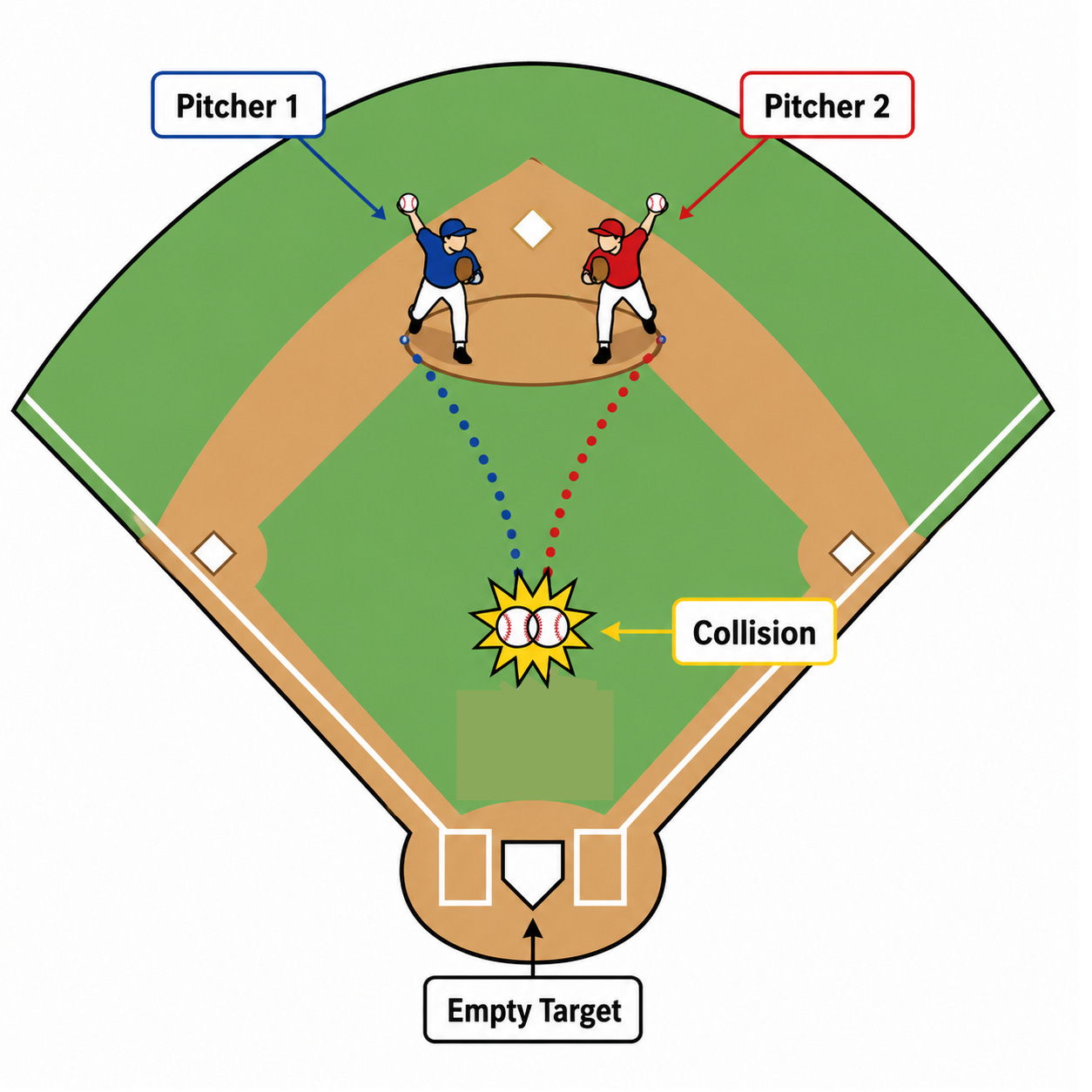
How? The only possible explanation is that the balls collided in midair before either one reached the target. You didn’t see it happen, but you know it did because the evidence, or rather the lack of evidence, tells you so. The empty target is the proof.
Remember this idea. It matters more than you think.
Step 2 - Superposition: One Pitcher, One Ball, One Mystery
Now let’s change it up. There’s only one pitcher. One ball, coated in paint. He’s throwing at the same target, over and over, in a pitch black soundproof room. You’re standing outside. You can’t see anything, hear anything, or observe anything at all.
After many throws you walk in and check the target.
It’s completely clean. No paint. Not a single mark.
Think about what that means. The pitcher never misses. You know the balls were thrown. But nothing hit the target. There is only ONE possible explanation. The ball somehow collided with itself! There was absolutely nothing else happening in that room and the pitcher confirms he threw every single paint-coated ball, one at a time at the target perfectly. His hand is covered with paint.
That is quantum superposition. The ball, at the subatomic level, existed in two states at the same time. It took two paths simultaneously, collided with itself, and canceled itself out before ever reaching the target.
This is not a metaphor. Not a theory. It is experimentally verified. A fact of our universe.
Step 3 - Observation: Just Turn the Lights On
Now, here’s where it gets truly weird(er)!
The moment you flip on the lights and watch the pitcher throw, the target gets hit. Every single time. The ball makes its mark.
Nothing about the throws changed. The pitcher is the same. The balls are the same. The target is the same. The only difference is that you’re now watching. And somehow, the act of watching the pitcher throw, observing, forces the ball to choose only one path. It stops existing in two states and commits to only one.
Somehow, the ball knows you are watching and it has to decide what path it will take. It didn’t have to decide when no one was observing. Much like every girl I asked out in high school, it kept its options open.
That’s what happened in the double slit experiment. The moment scientists tried to measure which path the electron took, it stopped behaving like a wave and started behaving like a particle. The observation itself changed the outcome.
We still don’t fully understand why. Nobody does.
How We Know Superposition is True
The baseball analogy is exactly what happened in the experiment done to test superposition, named the Double-slit experiment. Scientists shot electrons from an electron gun at a screen which could visually show where the electrons hit. A sheet with two slits cut in it was placed in between the gun and the screen. Electrons behave like a wave, meaning their path isn’t fixed or predictable.
When they turned on the electron gun and these electrons were fired randomly, the electrons that made it to the screen had to pass through one of the slits. The screen showed a pattern where interference must have occurred, because it was blank at parts that should have been hit. The only explanation, the electron passed through both slits at the same time and interfered with itself (hit itself like the baseball).
And when they put a measurement device on the slits to measure which slit the electrons passed through? No interference, only one slit used at a time.
So What Does This Actually Mean?
At the subatomic level, particles don’t have a fixed state until something interacts with them. They exist in all possible states simultaneously — and the act of measurement, of observation, of simply looking, forces reality to pick one. The universe at its smallest scale is genuinely, provably, deeply weird.
And you can’t really, truly understand and visualize this because it’s a world completely foreign to us as humans. We have never and will never exist in the quantum universe, the subatomic size. Much like a monkey will never be able to understand how a microprocessor works, our brains will never be able to understand quantum physics and superposition.
And I figured all of this out at a Mariners game.
So in summary - never go to a baseball game hungry and focused on the super tiny things in life. You may just leave more confused than ever.